Properties and color scales
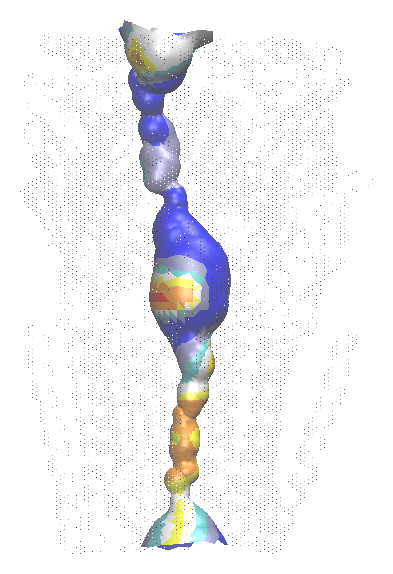
Property maps add physicochemical context to a geometric pore or tunnel. They do not convert a radius profile into a permeability calculation. Report the scale, lining definition, smoothing, and analysis mode with any property-colored figure.
Available properties
| Interface label | Quantity and source | Important restriction |
|---|---|---|
| Kyte–Doolittle | Residue hydropathy | Residue-level average |
| Wimley–White (interface) | Interfacial hydrophobicity | Residue-level average; CHAP uses its own compatible variant |
| Kapcha–Rossky | Atomic hydrophobicity assignment | Tunnel mode uses atoms in the tunnel lining |
| Fauchère–Pliska | Residue lipophilicity | Distinct from MOLE logP |
| Formal charge | Assigned residue formal charge | Not a pH-dependent electrostatics calculation |
| Grantham polarity | Residue polarity | Sequential scale |
| MOLE hydropathy, hydrophobicity, polarity, charge | MOLE lining-property tables | Distinct from similarly named pore scales |
| MOLE logP, logD, logS | MOLE residue lookup values | Do not substitute one for another |
| MOLE mutability | MOLE residue mutability lookup | Higher values indicate the table's variable end |
| MOLE ionizable | Count/indicator from MOLE residue assignments | Not a protonation-state calculation |
| Electrostatic potential | Relative potential in kcal mol⁻¹ e⁻¹ | Requires appropriate charge data |
| Water G(z) | Water free energy derived from density | Requires Hydration Compute |
| Water density | Water depletion field | Requires Hydration Compute |
Tunnel mode offers Kyte–Doolittle, Wimley–White, Kapcha–Rossky, Fauchère–Pliska, and the MOLE properties in the table. Electrostatic potential and hydration-derived properties are pore-only.
Non-protein residues in the selection
The residue-level scales (Kyte–Doolittle, Wimley–White, Fauchère–Pliska, Grantham polarity, and the MOLE tables) are amino-acid tables. A selected residue that is not in them — a glycan, lipid, ligand, or cap — takes a neutral placeholder value and is announced once per residue name in the console; no published value exists for such residues on these scales, so their colour is a placeholder, not a measurement.
Two schemes remain fully meaningful for heteroatoms: Kapcha–Rossky is atom-level — with partial charges loaded (PSF/topology) it applies the original |q| < 0.25 e rule to every atom directly, glycans included — and the water schemes (G(z), density) are computed from the water itself. Prefer those, or plain radius, when a glycan or lipid lines the region of interest. Formal charge is also correct for neutral sugars (zero).
The full numerical ranges and primary references are listed in References. Nonstandard residues absent from the MOLE lookup table receive a neutral fallback and generate a warning; assign their chemistry outside the plugin or interpret the aggregate cautiously.
How a slice receives a value
For residue properties, VMDHole identifies lining residues within the selected surface-distance shell, optionally applies the pore-facing filter, assigns each residue its table value, and smooths the result along the route. Pore and tunnel lining definitions differ, so aggregate values should not be compared across modes as if they were generated from the same samples.
Two independent distance controls have the same default:
- Pore lining threshold (default 3 Å) classifies lining residues for the lining/facing displays and residue-property averaging.
- Bottleneck shell (default 3 Å) selects residues for the constriction report.
Changing one does not change the other.
Where properties appear
The 3D surface, Pore Profile Fill, and Mean Profile synchronize a selected property where that property is available. Over Time has its own selector and Compute step.
After Hydration has been computed, Pore Profile Fill and Mean Profile offer trajectory-average Water G(z) and Water density. The 3D surface instead offers current-frame Water density when per-frame hydration data exist.
Unrolled map layers
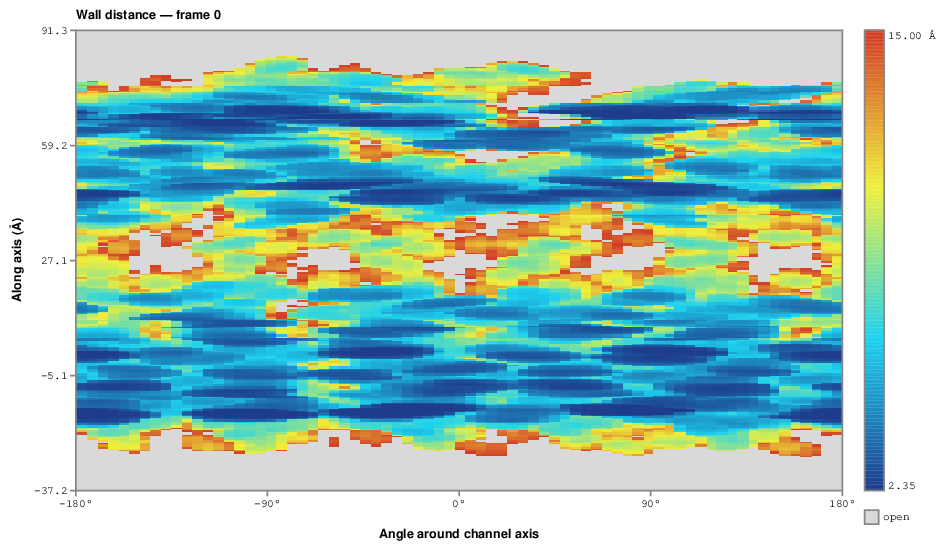
Unrolled maps use wall distance, oxygen/nitrogen identity, residue number, chain (or segment), and polarity. They also offer Kyte–Doolittle, Wimley–White, Fauchère–Pliska, formal charge, Grantham polarity, MOLE logP, logD, logS, mutability, and ionizable assignment. Polarity is its own wall classification, not formal charge.
After a Connolly run, Connolly reach reports the maximum radial extent of
the Connolly surface in each axial and angular map cell. Large patches identify
lateral expansions that can be examined as individual openings with the
pore_lobes surface color. This differs from Wall distance, which reports
the nearest pore-wall atom along a ray from the axis.
Reading colors
Read the legend, not color alone: its range stays fixed across frames. For a
signed property, the middle is zero; other properties run from low to high.
Water density is shown as depletion, 1 - ρ/ρ_bulk: positive values are below
bulk density and negative values are above it.